Thursday, February 24, 2011

Quy Nohn

After an overnight train ride (quite comfortable apart from the air con set to freezing and then abruptly to boiling) I arrived in Quy Nohn which was so hot I was a sweaty mess in seconds. The beach is quite lovely with the mountains behind and I visited two really stunning Cham towers. I also ate a hot pot of mixed seafood which was so fresh the fish were still swimming in tanks. Oh, and I also saw two Vietnamese barefoot runners, it's catching on folks!

The beach front


The view from a rooftop bar

Yet another pagoda

The Cham towers. These were used as temples when the Champa were around in 2nd to 15th centuries (only around 100,000 cham people still exist in Vietnam and most are muslim). Originally they were Hindu from Indian influences.

Another view of one of the Cham towers

Inside

Beach view towards the end of the day

Mekong Delta

I visited here on a foreshortened tour (never believe a Vietnam sales woman about finishing times, in fact just never believe a Vietnam sales person) because a two day tour would have meant missing my train to Quy Nohn. This was disappointing as I missed out on the floating markets and a home stay. Anyway, I did get to ride in a canoe (admittedly one filled with other tourists) and the speedboat tour back to Saigon was fantastic, watching the life on the banks of the river change and all the cargo boats go by. I tried snake wine, banana wine and some really lovely lotus flower honey. The snake wine is not too bad, but I am not convinced of it doing much except damaging your liver.

One of the canoes that I rode on

A Vietnamese rower

A water buffalo

Jackfruit growing on trees, I tried these which I am pretty sure are non-existent in the UK

A live-on boat

The man to the left is playing a piece of wire attached to the bamboo pole, it makes a kind of tinny sound that you associate with the East. The music was quite good, shame that the singing sounded like a strangled cat (never has that term been so appropriate)

Lots of Cargo boats on the Mekong river which begins in Tibet

There are various different sorts of housing on the riverside, varying from apartment blocks to shacks half falling in the water made of bush materials

A typical riverside scene

I saw this everywhere used as roof material so I presume that is what it's for

These were quite strange 'terraces' that were not joined up. They looked even odder from the air when I flew in, some just spring up in the middle of nowhere with no street, nothing

The Saigon part of the Mekong River which was very polluted and the driver kept having to stop to remove rubbish from the motor

Another part of Saigon where we finished our boat trip


Wednesday, February 23, 2011

Vietnam - Saigon (now Ho Chi Minh city)

Wow! I don't think I have ever seen so many motorbikes in one place. My head aches with all the concentration required to cross the road, and the constant noise. Everyone wears really cool retro sort of helmets, whether they protect your head or not I don't know. But I tried one on anyway for a quick ride on the back of a xe om or motorbike taxi. We only nearly crashed into another bike once, so I thought that was pretty good going. The best thing about Saigon, is the food. Its full of different flavours and it' s so cheap!

I visited the War Remnants Museum which was very eye opening. It was especially sad to see so many photos of torture carried out by American soldiers on unarmed Vietnamese villagers. I think war turns ordinary people into terrorisers. Also upsetting was the amount of photos of deformed children and adults who have ended up like that because of the agent orange dioxin the Americans sprayed everywhere. It is still affecting even third generation children, and one photo showed a deformed child born in 1997.

One of the markets near my hostel, you could still see the fish flopping about

The Opera House

I am not sure what this building is but it is very pretty

One restaurant where I had a delicious Vietnamese lunch


The post office, I think that is Ho Chi Minh at the back (celebrated here for bringing communism to Vietnam)

Pretty decorations everywhere

The streets are all lit up at night with lanterns and falling rain and of course millions of motorbikes

Inside one of the many pagodas in Chinatown in Cholon

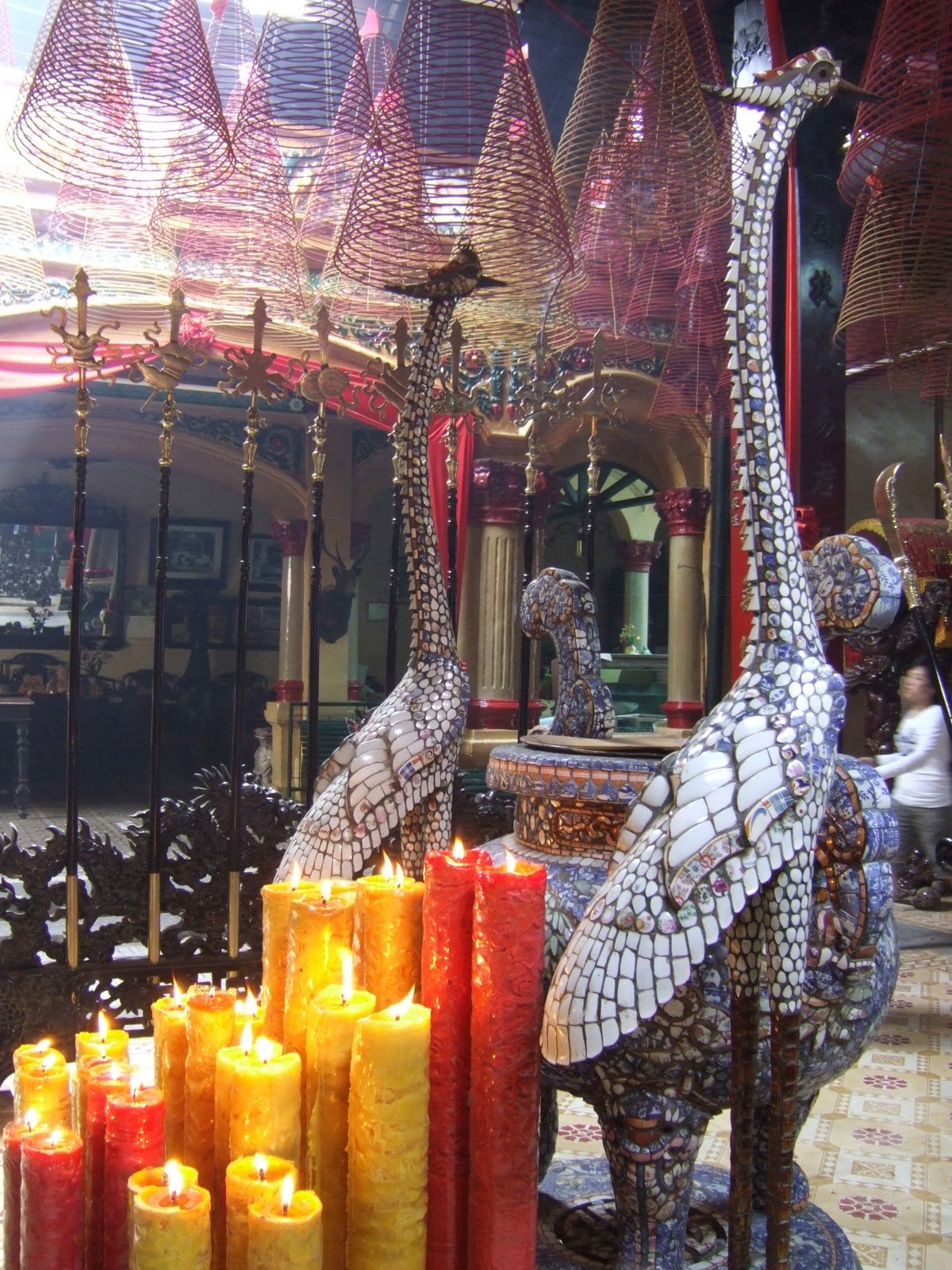
Another pagoda interior, the hanging cones are incense sticks, people light them when they come to the pagoda, in one pagoda there was also a statue of a horse and everyone rang it's bell when they left, very funny.

How many mushrooms?

Inside the Fine Arts Museum which was a French colonial building

The courtyard of the Fine Arts Museum

Snake wine is popular here and is known to cure many ills including impotence

Hotel de Ville (People's Committee Building)

More bikes

Yet more bikes and Cyclos (the ones used to carry people)

Singapore for one day (nearly)

After four flights from PNG to get here, I was shattered. But I got up and did a quick tour of the Jo Chiat area (china town) that I was staying in. There are some very pretty buildings here and even an Indian temple. Some of the terraces reminded me of terraces in Melbourne, I wonder which came first? The British were here in the 1800's so maybe that is the link. One interesting thing I found out is that the apartment blocks (with shops, cinemas, parks, religious buildings all included) are subjected to an ethnic integration policy which effectively prevents clusters of racial groups building up and causing tension. The three main races here are Chinese, Malay and Indian but everyone studies English as a first language and their second language depends on their heritage. I stayed at the Betel box hostel where I found out a lot of these things.


Terraces in the Jo Chiat area

A close up

A sweet, one side was coconut, the other a kind of bean

Unusual housing built up to avoid the floods they had back then

A Hindu temple

I liked these unusual trees

Sunday, February 20, 2011

Some final thoughts on PNG

Along this trip I have often thought how I have been really lucky that things have just fallen into place. One of the places where I have been particularly lucky has been PNG. Thanks to Nick who organises the cultural development unit, I was able to stay in the mining camp and use the office facilities, a real benefit to someone traveling without a laptop! I really learnt a lot about Lihir Island through talks with him and literature given to me. Also Patrick and Stanislaouse were a great help in organising my field work. I met many friendly and interesting people on the camp including Arthur who was a great training partner and kept me laughing every evening. There were also many stories about people's experiences in PNG off the island, which included being shot at and mugged. There was also an attempted rape on Lihir itself, though arguably this still makes it a lot safer than London! I was probably most worried about visiting this country over all the countries I have visited and it has been by far the most rewarding. It's definitely worth jumping right in sometimes!

Tuesday, February 15, 2011

Lihir Island Housing Analysis and Research

I came out to Lihir Island specifically to explore and evaluate my case study out here. This takes the form of homes designed and built by Assai architecture as part of the mining relocation programme on Lihir Island. Assai have won a World Habitat Award for their work in Papua New Guinea. The mining company initially installed kit houses on iron posts as relocation houses. These were very poor quality and received lots of complaints. However since replacement of materials, people seem to have adapted to them. After this the mining company brought in Assai architects who have a lot of experience working in Indonesia and Papua New Guinea. They came up with a type of house based on the traditional type of Papua New Guinea house but with longer lasting, better quality materials and fly screens. They incorporated a passive cooling system using apex vents to allow hot air to escape. They initially used a timber shakes roof but found it too problematic and expensive to produce so resorted to iron. The houses are on stilts, presumably drawn from the idea (like the Australian Queenslander) that air flowing beneath the house has a cooling effect. Since then the mining company have also built 6 concrete bungalows as a test for this type of house in the village of Kunaiye. It has been interesting to visit all of these house types and rate their success. With the help of Stanislaouse my research assistant I visited 3 separate villages on Lihir Island and the village on Malie Island. Carrying a big bag of betel nuts (a nut that when chewed turns your mouth red and gives a kind of kick and a hallucinatory effect. I was told by a villager it is the equivalent of drinking 6 glasses of wine in one go and can knock you out so not recommended for the uninitiated!) which are chewed continuously by all islanders, my interviews went very well and everyone was very happy to talk to me and very open. Unfortunately I have found out that the Assai houses are not very well liked by the villagers due to their being too hot, too small for a family and causing issues with local customs. Here there is a custom that the woman should not be on top of the man, as you can see from the picture below, it is possible for a man to be sitting downstairs and not realise a woman is sleeping upstairs. Many villagers have overcome this problem by filling in beneath the house to incorporate a sleeping area for the women. There were also issues with driving rain coming in through the windows facing the sea as these are not glazed, just fly screened. This was in a bid to remove parts requiring maintenance. I do have quite a lot of sympathy for the architects because these villagers are in transition. The mine has brought with it a very quick kind of modernisation and they are struggling to keep up. They are almost unconsciously ignorant as they do not know what they want as they have never experienced it before. Also there is the problem that as their land is being taken by the mine they expect a big impressive house in return. The existing bush type house made of bamboo for the walls and sago leaf for the roof is ideal for this climate as it allows a lot of ventilation (it was also by far the coolest house I went in).  But this is not big or impressive enough to justify their loss of land. The problem is therefore how to build something here that respects their culture, embraces modernity (to a degree) and deals efficiently with a tropical climate without relying on air conditioning. It is easy for me to criticise something already built, but Assai had to come out here and start from scratch. 


There have also been some successes. The rain water collection (possible from an iron roof but not from a sago leaf one!) works very well and the saw dust toilets work well with the mining staff but not with the villagers due to lack of education about what should be put down there!

The mining company asked me to submit a report of my research in return for the free accommodation I received. In this I also suggested that in future houses, they might like to place more emphasis on shade, vegetation and ventilation. The houses that I visited that were in shade for the hottest part of the day were infinitely cooler and much more pleasant to be in. Like the architecture of Glenn Murcutt and Lindsay Johnston, employing a secondary roof,  allowing cool air to flow between the roofs, creates a cooling effect like that of sitting under a tree.

There are also differing expectations of comfort on Lihir Island. The expat community are not good role models for the Lihirians. They drive the shortest distances in large trucks, I was a rarity on the island - a white person walking! They also expect air conditioning everywhere. The type of cool achieved just with sea breezes does not meet expat expectations so consequently air conditioning can be seen blasting out all day and night all over the island. Already the village people are asking for this in their relocation houses. I am wondering if it is a lost cause after all, trying to create an alternative. The energy comes from a geothermal power station, which will disappear when the mine goes, possibly in 2050. So there is also the issue about if the Lihirians get used to power, how will they cope when the mine has gone? Solar panels have been installed on the Malie Island houses which seems to be mostly successful.


I am not quite sure why the mining company decided to build 6 concrete bungalows in Kunaiye (except for the obvious low maintenance reason) because the thermally massive material just causes the heat absorbed during the day to be emitted at night. This means the villagers are sleeping outside because it is too hot inside. The villagers only really use their houses for sleeping and storage. Social occasions occur outside and I always found them sitting outside under a tree or in shade. The concrete houses only allow for successful storage!


The Assai designed house


Another example of an Assai designed house, they were deliberately varied in style

Showing how the villagers have built in underneath to allow the woman to sleep downstairs and to provide more space

Lack of vegetation around this house and no trees, meant these poor people were frying!

People cluster underneath the houses during the day as it is too hot upstairs

An example of a first type house built by the mining company relocation programme. It is basically a kit house and the material quality is very poor resulting in rusting iron posts and floorboards that children fall through. Clement, standing outside his house is one of the elder/chiefs on Malie Island

A few of the first type houses on Malie Island

Stanis my research assistant's house. They have raised their first type house and built underneath. The house was very cool due to shading and the hill blocking out the midday and western sun. They rent out one room downstairs to Highlanders who come here to sell produce.

This is a recent housing type that the mining company are trying out on Lihir Island. The rooms are bigger and it does not cause problems with local customs, but because the house is made of concrete, it absorbs all the heat during the day and then emits it at night. Consequently all the villagers complained that they were too hot at night and sleeping outside.

This is the original house type on Lihir and Malie Islands, before the mine arrived. The sago leaf roof and the bamboo walls allow lots of cross ventilation to occur. This was by far the coolest house that I went into. However there are issues with expectations from the villagers. The mining company is taking their land, so they expect something grand in return. This is actually the most culturally and climatically appropriate house but the difficulty has been translating this into a modern building that the villagers can be proud of.

An iron roof means modernity to the Lihirians so this house shows a traditional house with an iron roof but a sago leaf roof over the verandah. This house was extremely hot inside due to the heat transmitting through the iron roof. It seems they would rather suffer in the heat than appear not wealthy or modern.